
Author: Emily O'Gorman, Marketing Manager, Metro Supply Chain
Date updated: November 12, 2026
Key takeaways:
The signs your organization has outgrown its current 3PL, and what to look for instead:
- Your team is spending too much time managing fulfillment issues. Instead, your third-party logistics provider should proactively identify risks, communicate issues and resolve problems quickly and transparently
- Your business has become more complex, but your 3PL can’t keep up. A strategic logistics partner should be able to support multiple channels, service models, customer requirements and growth initiatives without compromising quality.
- You can’t fully see or trust the data. Your contract logistics provider should provide real-time visibility into inventory, orders, service performance and operational trends, and enable proactive decision-making.
- Service levels are becoming harder to maintain. Your 3PL should have the infrastructure, processes, technology and workforce required to consistently meet service commitments.
- Your 3PL delivers services, not strategy. Businesses today need a 3PL partner that can provide strategic guidance and supply chain resilience to help organizations adapt and stay competitive.
Introduction
As organizations grow, their supply chains become more complex.
New sales channels emerge, product portfolios expand and customer expectations rise. Service-level requirements become more demanding, while executive teams need greater visibility into operational performance and risk.
Yet some organizations still rely on logistics partners chosen for an earlier stage of the business, whose capabilities no longer match their evolving needs.
A 3PL that met the needs of a business with eight-figure revenues may struggle as it grows. A provider that served a regional network well may not be equipped for national expansion, omnichannel fulfillment or rising customer service expectations.
The question is no longer just whether your 3PL can store and move products, but whether it can help your business scale.
Leading brands expect logistics providers to go beyond transactions, delivering the visibility, resilience, innovation and strategic guidance needed to support broader business objectives.
“Customers need more than warehouse space. They need partners they can trust to navigate complexity, improve visibility and support growth in an ever-changing supply chain environment,” says Dan Peacock, President of Supply Chain Solutions at Metro Supply Chain. “At Metro Supply Chain, we combine operational excellence, technology and deep industry expertise to help customers improve performance, adapt to change and build resilient, scalable solutions. Through partnership, we deliver accountability, continuous improvement and long-term value.”
Here are five signs your organization may have outgrown its current 3PL relationship, and what enterprise supply chain leaders should expect instead.
1. Your team is spending too much time managing fulfillment issues
Enterprise supply chain leaders should not spend their days escalating support tickets, investigating inventory discrepancies, chasing shipment updates or resolving recurring service failures. Yet a reactive 3PL relationship forces them to do just that. Order accuracy declines, inventory counts need constant reconciliation and support requests take longer to resolve. Leadership meetings shift from business improvement to exception management.
As operations become more complex, internal teams spend more time compensating for their provider’s shortcomings. A mature logistics partnership should ease that burden, not add to it.
Executive expectation:
Your 3PL should proactively identify risks, communicate issues before they become disruptions and resolve problems quickly and transparently. Achieving this requires more than responsive support. It requires the right combination of technology, processes and operational expertise to identify issues early and accelerate resolution.
This may include:
- Real-time inventory and order visibility through integrated WMS, TMS and control tower platforms
- Automated alerts and exception management workflows that identify at-risk orders before service commitments are missed
- Dedicated account management and operations teams with clearly defined escalation procedures
- Business intelligence dashboards that provide actionable insights, not just raw data
- Scenario planning tools that help organizations evaluate options during disruptions, such as rerouting inventory, changing transportation modes or reallocating stock across facilities
The strongest logistics partners act as an extension of your supply chain organization, helping your team spend less time managing exceptions and more time focused on growth, customer experience and strategic initiatives.
2. Your business has become more complex, but your 3PL can't keep up
Over the past decade, many organizations have expanded their sales channels, customer base and fulfillment requirements.
B2B operations now run alongside direct-to-consumer fulfillment, while retail compliance requirements grow more demanding. Product customization, kitting, value-added services and customer-specific requirements add further complexity.
Yet many 3PL providers rely on standardized operating models that cannot readily adapt to these demands. The result is more manual workarounds, service limitations and operational inefficiencies.
A fulfillment model designed for a single channel or regional footprint may no longer fit the business it serves.
Executive expectation:
A strategic logistics partner should be able to support multiple sales channels, fulfillment models, customer requirements and growth initiatives without sacrificing service quality, visibility or operational control.
As supply chains become more complex, that flexibility is increasingly important. A McKinsey Global Supply Chain Leader Survey found that 73% of organizations have advanced dual-sourcing strategies, while 60% have regionalized portions of their supply chains to reduce risk and improve responsiveness.
The technology underpinning the network should be equally flexible. A modern order management system (OMS) should provide visibility across inventory and fulfillment locations and intelligently route orders based on predefined business rules. This enables orders to be fulfilled from the optimal distribution centre, store or other inventory node based on factors such as inventory availability, customer location, service requirements and delivery timelines.
For omnichannel businesses, the OMS should also support fulfillment models such as buy online, pick up in store (BOPIS), ship from store, store replenishment and multi-node fulfillment. This gives businesses greater flexibility in how inventory is positioned and deployed, helping them adapt as demand shifts, new channels emerge or the distribution network expands.
Ultimately, scale and flexibility should be built into the operating model and technology infrastructure, not treated as exceptions that require costly workarounds every time the business changes.
3. You can't fully see or trust the data
Executives today are expected to make faster decisions with greater confidence. That requires timely, accurate information.
If inventory data requires constant validation, reporting is delayed, or operational metrics are difficult to access, leaders are forced to make decisions based on assumptions rather than facts.
For many organizations, this challenge extends beyond reporting. It affects purchasing decisions, inventory planning, customer service, financial forecasting and overall business performance.
A lack of visibility often reveals itself through:
- Recurring inventory discrepancies
- Unexpected stockouts
- Delayed receiving processes
- Difficulty identifying the root cause of operational issues
Executive expectation:
Your logistics provider should provide real-time visibility into inventory, orders, service performance and operational trends, and enable proactive decision-making. The right information allows organizations to anticipate disruptions, improve inventory accuracy and identify opportunities before they impact customers.
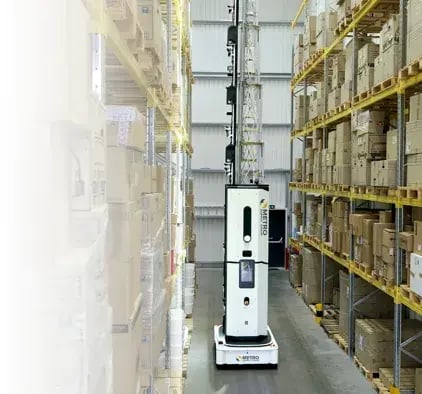
In one inventory-management implementation, Metro Supply Chain combined autonomous scanning with live dashboards, reducing manual cycle counting by 95% and accelerating discrepancy investigations by 75% within three months. Inventory-management case study.
For example, ahead of a customer promotion, outdated inventory records can mask delayed inbound shipments and lead to stockouts. Timely visibility lets teams adjust replenishment plans before customer orders are affected.
Data shows where you stand. Visibility shows what’s ahead, so you can act before problems arise.
4. Service levels are becoming harder to maintain
Rising order volumes and customer expectations expose operational weaknesses:
- Orders ship late
- Inventory receiving falls behind schedule
- Peak periods create bottlenecks
- Customer complaints increase
- Support teams spend more time explaining delays
What once seemed like isolated exceptions becomes a pattern of service failures, putting customer satisfaction, revenue and brand reputation at risk.
Every operation faces occasional disruptions. The warning sign is when service failures become predictable rather than exceptional.
Executive expectation:
Your 3PL should have the infrastructure, processes, technology and workforce to meet service commitments consistently, even during rapid growth, seasonal peaks or unexpected market disruptions.
Can your 3PL respond when a successful product launch doubles order volumes, peak demand arrives early or port delays require real-time changes to inbound plans?
A scalable 3PL should absorb these pressures with minimal impact on service. That requires access to additional warehouse capacity, flexible labour models that scale staffing quickly, technology that prioritizes urgent orders and standardized processes that prevent bottlenecks as volumes grow.
For a speciality retailer, Metro Supply Chain supported more than a doubling of Canadian store while maintaining strong peak performance and achieving 99% on-time delivery. Retail growth case study.
The real test is not performance on an average day, but the ability to maintain service when conditions become challenging.
As your business grows, reliable execution should become the norm, not harder to achieve.
5. Your 3PL delivers services, not strategy
Historically, many logistics relationships were built around execution.
- Can the provider store inventory?
- Can the provider ship orders?
- Can the provider meet service-level requirements?
These capabilities remain essential, but they are only the starting point.
As supply chains play a greater role in business performance, executive teams need partners that look beyond day-to-day execution to help shape long-term strategy.
That means identifying improvement opportunities, optimizing costs, strengthening resilience and supporting growth. Without this strategic contribution, the relationship remains transactional and innovation stalls.
Executive expectation:
Geopolitical uncertainty, from changing tariffs to disrupted trade routes, is reshaping global supply chains. To adapt and stay competitive, businesses need a 3PL partner that offers strategic guidance and deep expertise in customs and cross-border trade, risk management, network design, inventory optimization and supply chain resilience.
According to McKinsey, 82% of global supply chain leaders report that tariffs directly affect their operations, with the average company experiencing disruption to 20 to 40% of its supply chain costs. At the same time, customers expect faster fulfillment, higher availability and greater transparency, putting pressure on businesses to meet rising service expectations while keeping costs under control. A strategic 3PL partner brings the expertise, processes and infrastructure to help organizations adapt operations smoothly and remain resilient.
Your strategic partner should be ready to discuss:
- Network optimization
- Capacity planning
- Growth strategies
- Inventory optimization
- Risk mitigation
- Customer experience
- Cost-to-serve performance
- Supply chain resilience
- Automation opportunities
- Continuous improvement initiatives
The strongest partnerships translate logistics execution into measurable business outcomes.
Executive scorecard: Is your 3PL reactive or strategic?
|
Capability Area |
Reactive 3PL |
Strategic 3PL |
|
Inventory accuracy |
Frequent reconciliations required |
High confidence in inventory data |
|
Operational visibility |
Limited or delayed reporting |
Real-time operational insights |
|
Scalability |
Growth creates friction |
Growth is built into the operating model |
|
Customer support |
Reactive and issue-driven |
Proactive and accountable |
|
Service reliability |
Performance declines during peak periods |
Consistent performance at scale |
|
Flexibility |
Standardized processes limit adaptability |
Supports evolving business requirements |
|
Technology enablement |
Data explains past issues |
Data drives future decisions |
|
Continuous improvement |
Little ongoing optimization |
Regular performance and process improvements |
|
Strategic value |
Executes transactions |
Contributes to business objectives |
|
Executive alignment |
Focused on SLAs alone |
Focused on growth, resilience and customer experience |
Checklist: what leading brands should expect from their 3PLs today
When evaluating your next 3PL, look for a partner that can provide:
✓ High inventory accuracy and operational reliability
✓ End-to-end visibility across inventory and order activity
✓ Responsive, accountable customer support
✓ Enterprise-scale operational flexibility
✓ Proactive risk management
✓ Transparent pricing and cost control
✓ Continuous improvement
✓ Proven investment in innovation and automation
✓ Technology-enabled decision-making
✓ Strategic guidance and industry expertise
✓ Alignment with long-term business objectives
As supply chains become increasingly critical to growth, profitability and customer experience, the role of the 3PL continues to evolve.
The organizations that build strong logistics partnerships will be better positioned to manage disruption, support growth and create lasting competitive advantage.
Connect with Metro Supply Chain to discuss how we’re helping leading organizations build more resilient, scalable, and future-ready supply chains.
Related Posts
5 signs an organization has outgrown its current 3PL and what to look for next
How Metro Supply Chain helped a leading specialty retailer build a more scalable, efficient supply chain
Modernizing kitting-line operations through end-to-end automation
Archived Posts
- september 2024
- january 2024
- february 2024
- march 2024
- may 2024
